
Martin County Arrest Records and Court Charges
Martin County arrest records start on the law-enforcement side. The Sheriff's Office, Fairmont Police Department, or another agency may make an arrest, book a person into jail, prepare reports, or forward an investigation for charging review. The public jail roster can show booking date, arresting agency, charges, custody status, projected release date, and bond amount when a person is in custody. For custody-only details, the better route is the Martin County inmate records page.
Court charges after arrest begin when the prosecutor files a charge in Martin County District Court. The County Attorney's Office reviews law-enforcement evidence and decides whether a petition, complaint, citation, or other charging document should be filed. Once filed, those charges become part of the court charge record. Later pleas, dismissals, convictions, sentencing, and probation events belong to the broader Martin County criminal court records file.
Charges After Arrest in Martin County
The Martin County Attorney serves as chief prosecutor of adult crimes and juvenile offenses committed in the county. The office also contracts with cities including Ceylon, Dunnell, Fairmont, Granada, Sherburn/Welcome, Trimont, and Truman to prosecute petty misdemeanors, misdemeanors, and certain gross misdemeanors. The County Attorney does not investigate crimes for private citizens. Law enforcement investigates and submits cases for charging review.
The prosecutor must have probable cause, meaning facts sufficient to believe a specific defendant committed a specific offense. If a charge is appropriate, the formal filing goes to District Court and appears in the court case record when public. A single arrest can produce one charge, several charges, no filed charge, or later amended charges. That is why the arrest record and the court charge record should be checked separately.
Martin County Probation becomes relevant after sentencing, supervision, or juvenile intervention, not at the initial arrest stage.
Probation records help explain later supervision terms that can follow a charge disposition.
Charging Documents in Martin County
The charging document is the formal paper that turns an arrest or investigation into a court charge. Minnesota research for Martin County identifies the complaint and petition route in the local prosecution process. Citations can also create court cases, especially in traffic and petty misdemeanor matters. Indictments are less common and come from grand-jury action in serious matters.
| Document | Who Uses It | What It Starts | What to Check |
|---|---|---|---|
| Complaint | Prosecutor, often based on law-enforcement reports | A criminal case alleging one or more offenses | Charge count, statute, probable-cause facts, severity, and filing date. |
| Information / Petition | Prosecutor | A formal prosecution or juvenile matter, depending on case type | Defendant or juvenile role, offense, requested court action, and next hearing. |
| Indictment | Grand jury | A serious criminal prosecution when grand-jury action is used | Offense counts, statutory basis, and district court filing details. |
Martin County Charge Status
A charge status can change as the case moves through court. The first filed charge is not always the final outcome. Prosecutors can amend or reduce charges. The court can dismiss a count. A plea can resolve one count while others are dismissed. A conviction can lead to sentencing, probation, fines, restitution, or other conditions. MCRO and the court record should be read by count, not just by case caption.
| Status | What It Means | Where It May Appear |
|---|---|---|
| Pending | The charge has not reached a conviction or final outcome. | Charge list, hearing search, or Register of Actions. |
| Amended | The filed charge was changed, often by count, statute, severity, or wording. | Complaint, amended complaint, case events, or disposition rows. |
| Reduced | The charge was changed to a lower severity or different offense. | Plea terms, amended charge details, or sentence records. |
| Dismissed | The court or prosecutor ended the charge without conviction on that count. | Disposition field, order, or Register of Actions. |
| Convicted | The charge ended in adjudicated guilt by plea or verdict. | Disposition, sentence, and financial sections. |
Find Martin County Arrest Records
To look up Martin County arrest records and charges, start by deciding which side of the event matters. Current custody and booking information is checked through jail or sheriff channels. Filed charges and charge status are checked through MCRO and Court Administration. Court charges after arrest may not appear by defendant name if the criminal, traffic, or petty misdemeanor case is pending and has no conviction. A case number, citation number, or attorney search may be needed.
- Check the jail roster route when the question is current custody, booking date, arresting agency, bond, or custody status.
- Use MCRO Case Search by case number, citation number, or attorney search when the question is filed charges.
- Select Martin County and the Criminal case category when filtering court charge records.
- Read each count for statute, offense title, severity, disposition, warrant flag, bond, and sentence terms.
- Contact Court Administration for certified court copies or the Sheriff's Records Department for agency reports.
Martin County Victim/Witness services can help victims with hearing notices, charge information, offender status, victim impact statements, and court support.

That local office is relevant when charge information is tied to victim notice or courtroom support.
Charge vs Conviction
A filed charge is not a conviction. It is an accusation that has entered the court system. A conviction requires an adjudicated finding of guilt, usually through a guilty plea or verdict. Martin County arrest records and court charges may show accusations that later change, reduce, dismiss, or resolve without a conviction. That difference is central to reading charge records after arrest.
| Point | Charge | Conviction |
|---|---|---|
| Meaning | Formal accusation filed by prosecutor or citation process. | Adjudicated guilt under Minnesota law. |
| Timing | Early in the case, after investigation, citation, or arrest. | After plea, verdict, or qualifying court finding. |
| Proof level | Probable cause supports the filing. | Beyond a reasonable doubt or valid guilty plea. |
| Record result | May be pending, amended, reduced, or dismissed. | Can trigger sentence, probation, fines, restitution, and criminal-history effects. |
Charge Codes and Severity
Martin County court charge records can list an offense title, Minnesota statute, severity level, count number, and disposition per count. A charge may be a petty misdemeanor, misdemeanor, gross misdemeanor, felony, or juvenile allegation depending on the offense and case type. The same arrest can have multiple counts with different severity levels and different outcomes.
Minnesota Statutes section 609.02 defines key criminal-law terms used in charge and conviction analysis.
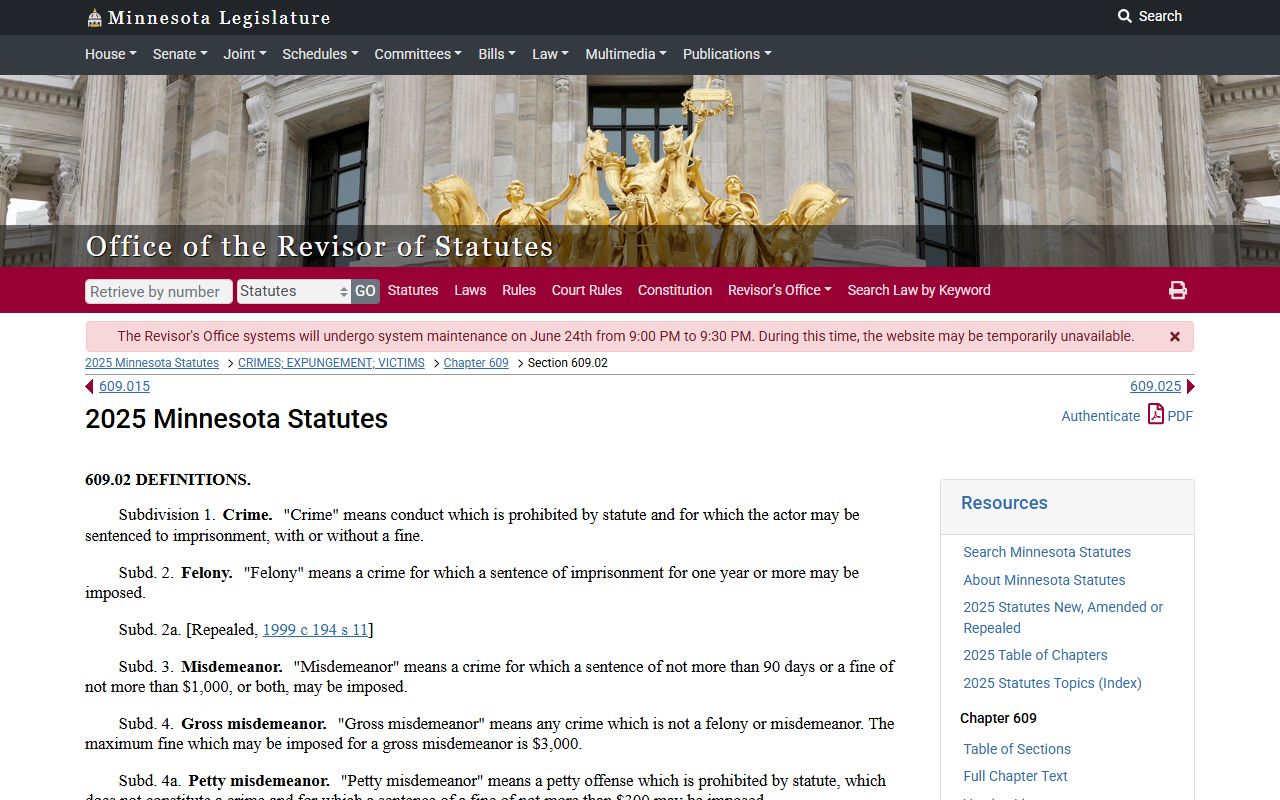
The statutory definitions help explain why pending charges and convictions are treated differently in court-record searches.
Sealed and Expunged Charges
Some Martin County arrest records and charge records can be restricted, sealed, or expunged. Juvenile records, sealed records, civil commitment matters, and certain sensitive records are not ordinary public records. Minnesota expungement law can seal qualifying records relating to arrest, indictment or information, trial, or verdict. Recent Clean Slate changes also affect whether older qualifying criminal records appear to the public.
| Point | Sealed | Expunged |
|---|---|---|
| Public access | Blocked from ordinary public viewing. | Blocked under Minnesota expungement authority. |
| Record existence | The record still exists. | The record generally still exists, but access is limited. |
| Common route | Court order, statute, or court-rule restriction. | Automatic expungement or petition under chapter 609A. |
| Search effect | May not appear in MCRO. | May stop appearing after court and agency updates. |
Minnesota Statutes chapter 609A is the criminal-record expungement chapter.
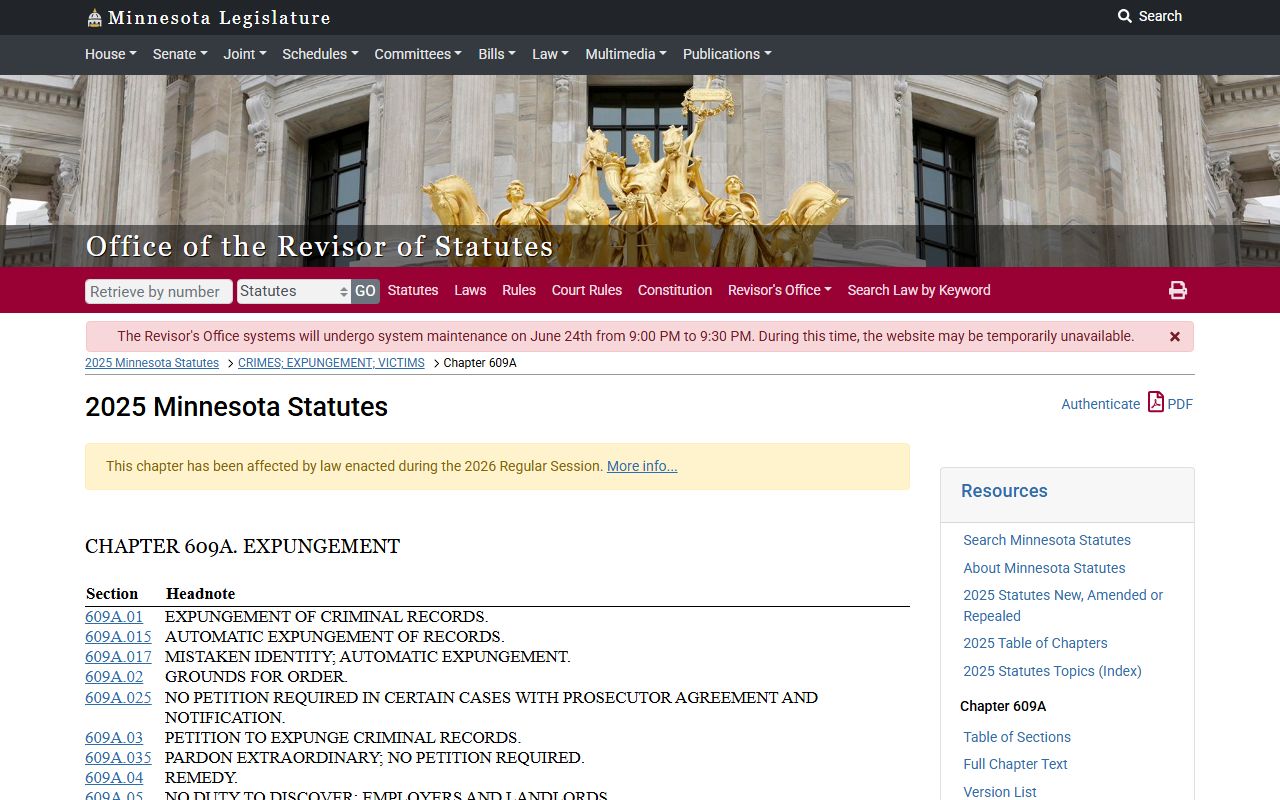
Chapter 609A is the starting point for understanding why a charge or arrest record may no longer show publicly.
Minnesota Statutes section 609A.02 lists petition-based expungement grounds for some records.
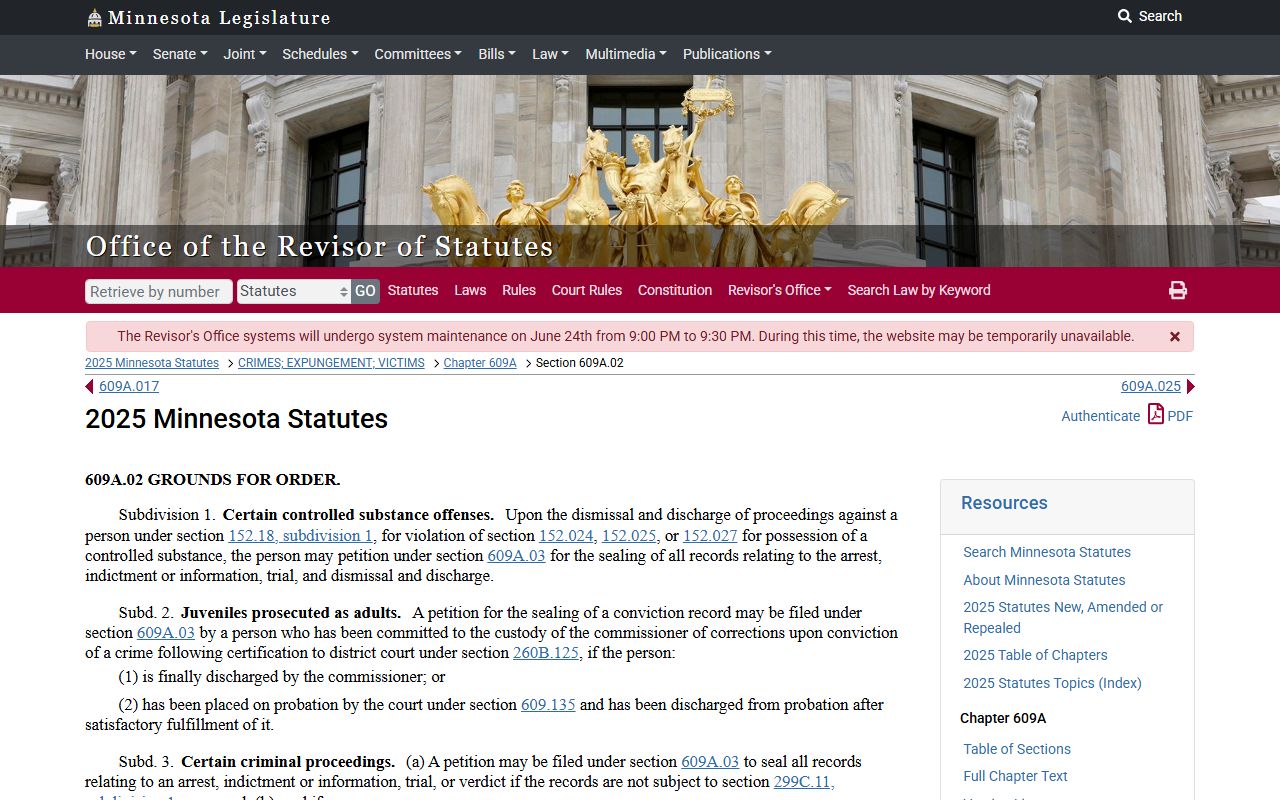
Eligibility depends on the record, disposition, waiting period, agencies involved, and current Minnesota law.
Martin County Charge Offices
The County Attorney's Office is at 123 Downtown Plaza, Fairmont, Minnesota. The office phone is 507-238-1594 and the general email is county.attorney@martincountymn.gov. Taylor L. McGowan is listed as County Attorney. Assistant County Attorneys Amanda L. Heinrichs-Milburn and Suelana Kinney are listed in the county source. The office works with the Victim/Witness Coordinator and with law-enforcement agencies that investigate crimes.
For the court file, use Martin County Court Administration at 201 Lake Avenue. For sheriff reports or booking records not shown in a public roster, use the Sheriff's Records Department or the county's public-records request portal when appropriate. The Sheriff's Records Department requires photo identification for reports, withholds cases currently under investigation, and releases records within a reasonable time to authorized people under law.
Martin County Attorney
123 Downtown Plaza
Fairmont, MN 56031
507-238-1594
county.attorney@martincountymn.gov
BCA Criminal History vs Charges
The Minnesota BCA Criminal History Search is separate from MCRO. BCA criminal history is the proper route when the goal is a criminal-history background search. MCRO is a court-record portal that shows public case information, hearing information, documents, and judgments within Minnesota District Court access limits. Neither route should be used for FCRA-regulated employment, tenant, credit, or insurance decisions unless the user follows the law that applies to those decisions.
A Martin County arrest record, a filed court charge, a BCA criminal-history result, and a final criminal disposition can each answer a different question. The safest charge review follows the case from arrest or citation to complaint, status changes, plea, dismissal, conviction, or sentence.
Important: Arrest records and filed charges can be incomplete without the later disposition and sentence.